

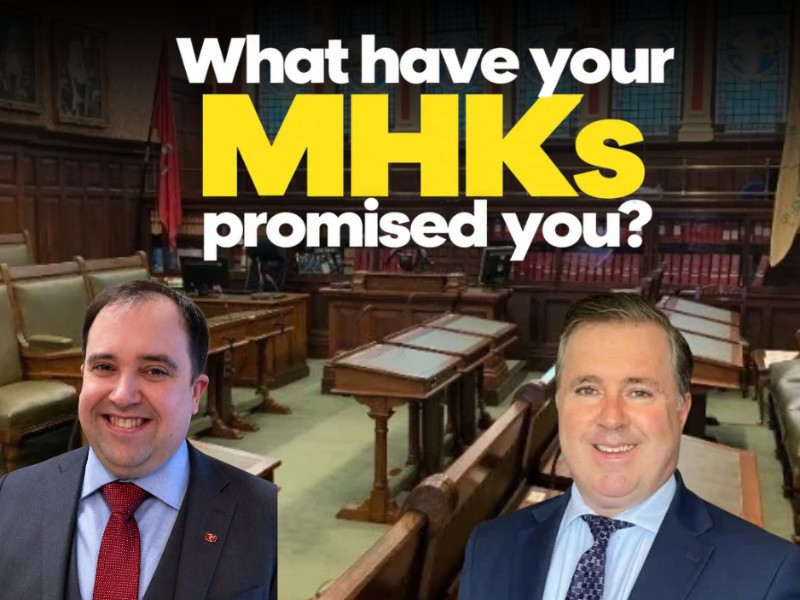
David Ashford and Damian Ciappelli were elected
Following the sad and untimely death of John Wannenburgh in the summer, the voters of Douglas North chose experience with David Ashford topping the poll, with the second seat going to Damian Ciappelli.
Both men were pushing for major reforms in different areas and both pushed for improved government.
Mr Ashford has since gone on to be elected as the new Speaker of the House of Keys.
Housing
Mr Ashford made housing the centrepiece of his campaign. As Chair of the Housing and Communities Board, he led the publication of the Island's first Objective Assessment of Housing Need and the policy response proposing a ten-year programme to build up to 1,000 affordable homes. He wanted a housing delivery dashboard covering starts, completions, stalled sites, and affordable tenure. His flagship new policy was a Housing Deposit Guarantee Scheme, which would see government guarantee up to 20% of a mortgage deposit (max £80,000) for up to 100 first- or second-time buyers each year, allowing banks to offer 100% mortgages with minimal taxpayer exposure. He argued this would open up the market without inflating prices.
Mr Ciappelli supported faster delivery of affordable homes, better use of publicly owned land, and planning policies based on actual need. He said housing organisations should be judged by the homes they delivered, not the plans they produced. He also wanted any future population growth matched by the homes, healthcare, schools, and infrastructure required.
Energy
Mr Ashford approached energy with caution. On offshore wind, he refused to say yes or no because doing so would have disqualified him from considering the planning application. He set out three tests: what benefit would flow to Island residents (not just government coffers), what independent studies showed about marine impact, and whether a decommissioning bond was paid upfront. He supported the climate change fund's focus on insulating homes, arguing that helping people with bills was a sensible use of taxpayer money.
Mr Ciappelli supported a moratorium on onshore and offshore wind farm developments until sufficient expert and legal opinion was gathered. He argued major energy projects committed the Island for decades and government must explain true costs, financing, environmental effects, and alternatives before approval. He believed residents should have the final say. He advocated practical energy reduction measures like insulation, double glazing, and efficient appliances.
Government Reform
Mr Ashford supported a directly elected Legislative Council and wanted collective responsibility relaxed so ministers who formally disagreed at Council of Ministers could vote against government in Tynwald. He supported government operating more clearly as one organisation where it removed duplication, but insisted any structural reform must publish transition costs and demonstrate genuine savings. He said the size and structure of government must be a priority for the incoming administration.
Mr Ciappelli went further, advocating a unified government model, moving away from the current system of eight separate departments (which he described as effectively separate legal corporations) towards a single legal entity similar to the Channel Islands. He argued this would encourage joined-up thinking, reduce duplication, and enable significant savings. He saw this as the catalyst for tackling the Island's £125 million structural deficit.
The Economy
Mr Ashford wanted growth that raised living standards, not growth for its own sake. He supported continued development of financial services, insurance, eGaming, professional services, construction, engineering, and tourism, while building depth in cyber security, AI, data services, and life sciences. He backed an evidence-based minimum wage approach, stronger enforcement of employment rights, and tax allowances that protected lower and middle earners. He supported a "Right People, Right Skills" immigration policy of local workers first, local training as the first response to shortages, controlled inward migration where genuine skills gaps existed.
Mr Ciappelli focused on government spending and borrowing as the toughest issue. He wanted to reduce duplication, control administration costs, and stop funding activities that didn't deliver results. He supported a Young Entrepreneur Scheme with start-up assistance and business mentors. He wanted a practical digital strategy that improved services and productivity. On immigration, he said population growth should not be a goal in itself and only supported policies that attracted needed skills, considered overall impact, protected local jobs, and prevented worker exploitation.
Education
Mr Ashford prioritised early years, arguing the existing childcare credit didn't go far enough, particularly when families needed it most, from 12 months of age. He wanted to expand the scheme into early years to give parents more flexibility to return to work. He supported Island-wide screening and support pathways for dyslexia and dyscalculia, with defined timescales. He backed a single skills plan developed with employers, expanding apprenticeships in construction, engineering, digital, care, and hospitality. He also wanted student-loan relief modelled for graduates returning to priority public-service and economic skills.
Mr Ciappelli said young people should not feel they must leave the Island permanently to find good jobs or affordable homes. He supported stronger apprenticeships and vocational training developed with local employers. He would have supported a Young Entrepreneur Scheme and wanted to look at ways of defraying childcare costs, which he described as sometimes being a "second mortgage" for families.
Steam Packet and Connectivity
Mr Ashford wanted a published shareholder mandate for the Steam Packet covering reliability, affordability, freight resilience, and customer service. He supported loyalty schemes for frequent travellers and fixed all-year-round pricing rather than demand-based pricing. On aviation, he wanted government to define a limited number of strategic links and, where the market could not provide stable year-round frequency, use transparent, competitively tendered public-service contracts with clear subsidy and performance conditions.
Mr Ciappelli wanted affordable and dependable passenger travel and reliable freight services from the Steam Packet. He said there appeared to be no agreed marketing and pricing strategy between the Steam Packet and Treasury, a significant omission, and supported developing one. He wanted to protect important air routes at risk and ensure Ronaldsway had enough qualified staff to avoid delays.
Local Government
Mr Ashford supported moving towards five stronger authorities, Douglas, East, West, North, and South, with suitable services devolved where they could be delivered more effectively locally. He opposed an all-Island rate, arguing local representatives should remain accountable for local services and the money raised to provide them. He said centralising with government removed democratic accountability.
Mr Ciappelli did not set out a detailed local government reform position in his manifesto, but his broader emphasis on government listening and restoring trust suggested he would approach structural reform cautiously, with a focus on scrutiny and evidence before committing public money
 Airline which services the Island announces further 700,000 seat cuts over winter
 Man spared jail after £46,000 phone thefts
 The Wing recommended for approval
 Manx Radio's speech output falls below that required by licence agreement
