
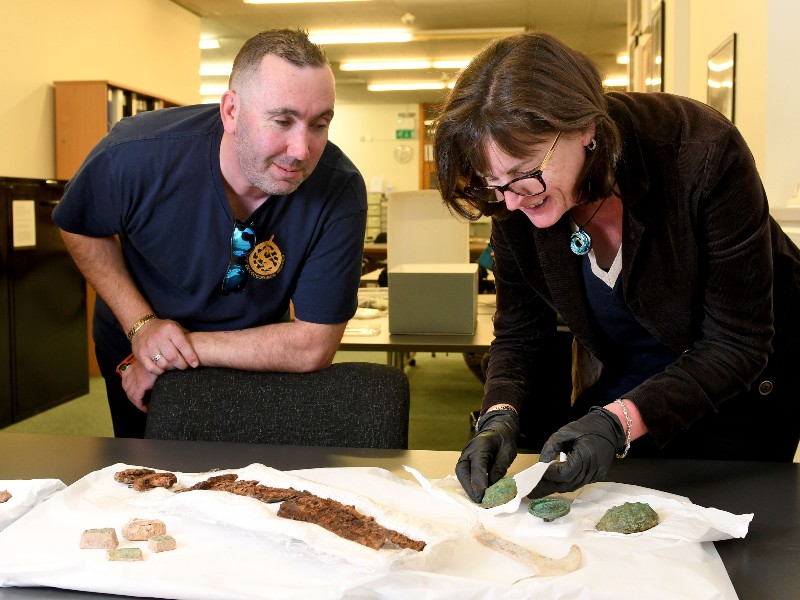
Weights found are the first of their type on the Island
A collection of Viking Age objects, dating back more than 1,100 years, has been declared Treasure.
Manx National Heritage said it offers new clues about the lives of some of the Isle of Man’s earliest Scandinavian settlers.
Discovered by metal detectorist Daniel Crowe, the collection items includes three bronze brooches, a Viking sword, trading weights and scales, a bronze ladle and an axehead.
Dating to around AD900, the objects are believed to have come from a double Viking burial.
The discovery is particularly significant because it dates to the earlier part of the Viking Age on the Isle of Man, when Scandinavian communities were becoming established.
Among the most significant finds are two oval brooches decorated with intricate patterns of interlocking animals, a distinctive feature of Viking art.
Remarkably, only one other pair has ever been discovered on the Island and one of the finders of that pair was none other than Daniel’s father, John Crowe and fellow metal detectorist Craig Evans.
MNH said the newly discovered brooches could be around 50 years older, potentially evidence of the earliest known female Viking Age burial on the Isle of Man.
A third brooch, originally gilded, decorated with spirals and with a glass centre, is the first of its kind discovered on the Island.
Sword
The collection also includes an elaborately decorated sword, the thirteenth Viking sword found on the Island.
Around two-thirds survives, including parts of its hilt decorated with fine silver metal inlay and twisted silver wire revealed through x-ray analysis. Only two other Manx Viking swords have been found with comparable decoration.
The presence of jewellery typically associated with women alongside a sword traditionally associated with men raises the intriguing possibility of a double burial, or separate graves dating to the same period. #
MNH said the original burial site was disturbed at some point during the past thousand years, so the precise circumstances remain uncertain.
The discovery also provides further evidence of trade and cultural connections across the Irish Sea. Decorated lead weights and fragments of bronze balance scales would have been used to weigh precious metals and coins during trading.
One weight features a decorative bronze fitting, possibly reused from a small chest or religious object, with an artwork style typical of Britain and Ireland at the time. It offers a fascinating example of how Viking settlers adopted and reused objects from other cultures.
A bronze ladle, possibly used for feasting or ceremonies, is another type of object not previously recorded on the Island.
Connections
Together, the finds reveal a picture of Viking life extending beyond warfare, highlighting the importance of family, craftsmanship, trade and connections with neighbouring communities.
Allison Fox, Curator for Archaeology at Manx National Heritage, said: “This is an extraordinary discovery and one of the most significant groups of Viking Age objects found on the Isle of Man. What makes it particularly exciting is the combination of finds, which gives us a rare opportunity to explore the lives of some of the Island’s earliest Scandinavian settlers.
"The brooches are especially important because they appear to represent our earliest known female Viking Age burial. Together with the decorated sword, trading equipment and other objects, they help us build a picture of the people who lived here more than a thousand years ago, how they traded and the connections they maintained across the Viking world.
"Although the original burial site has been disturbed, further research may reveal much more about these objects and the people who owned them."
Mr Crowe took particular care not to clean the objects, leaving them in their original condition for professional examination and MNH said that decision has helped preserve traces of archaeological evidence that might otherwise have been lost.
Fellow metal detectorist Rhett Britton assisted with the search, discovering the Viking axehead, part of the balance scales and additional iron objects.
Allison added: “We are extremely grateful to Daniel Crowe and Rhett Britton for their assistance, and to the landowner for their patience and cooperation. Daniel's decision not to clean the finds was particularly important, allowing us to preserve valuable evidence for further study.
"Manx National Heritage is also extremely grateful to the Radiology Team at Manx Care for their invaluable expertise and support in helping us uncover the secrets of these remarkable Viking Age artefacts.
"Before conservation work began, specialist scans allowed us to look beneath layers of compacted soil, revealing fascinating hidden details that would otherwise have remained unseen. These images provided vital information to guide our conservator through the delicate process of uncovering and preserving the objects. This collaboration is a wonderful example of how modern technology can help us unlock the mysteries of the past”.
With several objects being the first of their kind found on the Island, the collection offers an important opportunity to learn more about Viking settlement, burial traditions and everyday life.
Visitors will soon be able to see a selection of the newly declared treasure, which is going on public display in the Viking Gallery at the Manx Museum from Wednesday (11 November).
 Ard-Shirveishagh hopes he's given members enough time to consider 'Charter for Change'
 Live video streaming 'significant step' in making parliament more accessible
 Treasury: 'Challenging to justify support for heating oil customers'
 Increase of more than 500 patients for mental health services over last 12 months
