

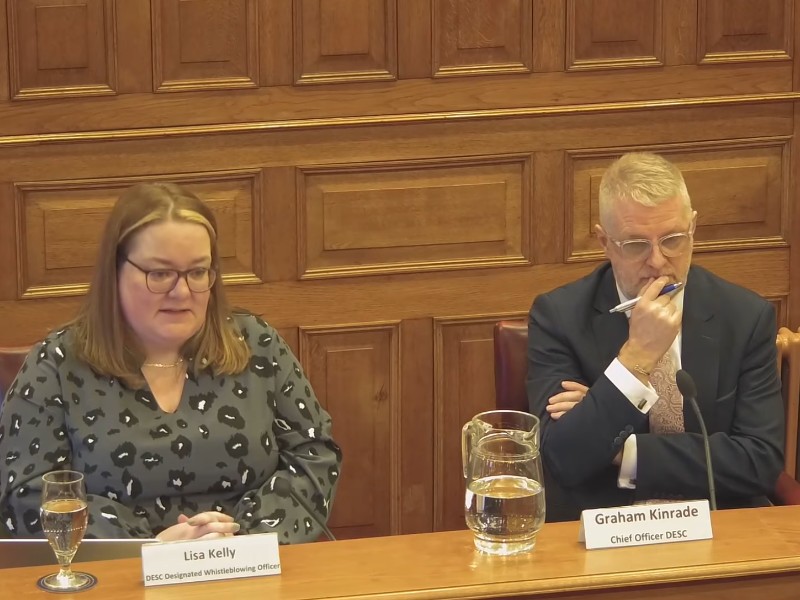
Graham Kinrade tells committee culture change takes time but says raising concerns is welcomed across government
The chief officer of the Department of Education, Sport and Culture has told a Tynwald committee examining whistleblowing that encouraging staff to raise concerns is central to improving organisational culture.
Giving evidence to the committee, Graham Kinrade said that since becoming chief officer in 2020 he has placed a strong emphasis on “people, relationships and culture” within the department.
He said building a positive culture starts with treating staff fairly and appropriately, recognising their contribution, and developing strong working relationships.
According to Mr Kinrade, creating the right environment for staff to raise issues is an ongoing process and one that will take time.
“I welcome people bringing forward complaints,” he told the committee, adding that concerns do not necessarily have to be raised through formal whistleblowing channels.
He said encouraging staff to speak up about issues helps organisations learn and improve.
Mr Kinrade also sits on the government’s Chief Officer Group, which brings together the senior leaders of departments.
Asked whether whistleblowing is discussed only when employment tribunals arise, he said conversations within the group are broader and focus on organisational culture and ensuring staff feel able to raise concerns.
He told the committee that chief officers across government recognise the need for improvement in this area, but that meaningful change will not happen overnight.
Mr Kinrade said his message to staff within the Department of Education, Sport and Culture to “speak up” if they have worries.
However, he also acknowledged that employees may feel more comfortable raising concerns with someone they already trust rather than approaching an unfamiliar reporting channel.
He said that instinct is understandable, but reiterated his message that staff should feel able to come forward if they have concerns:
Department of Health and Social Care
The interim chief officer of the Department of Health and Social Care told the committee protecting the anonymity of whistleblowers can be particularly challenging within a relatively small organisation.
Professor Tim O’Neill says the department has to be “super careful and vigilant” when handling disclosures, adding the issue has been discussed frequently during the nine months he has been in post.
He told the committee that he promotes a culture where staff recognise their responsibilities as public servants, saying there is an expectation employees behave in a certain way and uphold their duty to the public.
When asked how organisations can move towards a culture where whistleblowing is actively championed rather than feared, Professor O’Neill suggested progress would come as more people support the process.
“The more champions there are, the more chance it will become embedded.”
Appearing alongside him, the Department of Health and Social Care’s Designated Whistleblowing Officer Louise Quayle believes fostering “psychological safety” is central to encouraging people to raise concerns.
She told the committee the whistleblowing policy exists to deliver positive outcomes and that staff should not feel they will suffer any detriment for using it.
Ms Quayle acknowledged that building an environment where employees feel safe to speak up takes time, but said creating that culture remains an important priority:
 Tour guides ask for tram reinstatement
 Manxman's arrival into Douglas delayed due to weather
 "We are not going to discuss terms and conditions in a pay negotiation."
 Government in talks with Northern Ireland over fishing concerns
