
"No decision regarding the future participation of the Sidecar class will be taken until further work has been completed"
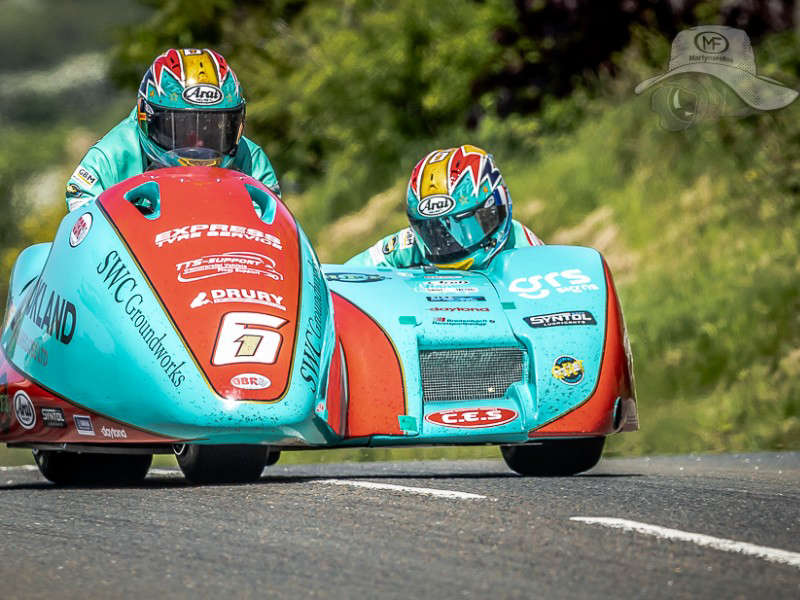
Organisers of the TT have confirmed the Sidecar class could return next year; but will face long-term reforms that will make machines slower.
The first-stage report of the organisers' Sidecar Sustainability Review was published this afternoon (Friday 31 July).
It marks the first conclusion of the initial evidence-gathering phase announced following the suspension of the Sidecar class during TT 2026.
The review is said to have included more than 460 public submissions, together with dedicated panels involving competitors, technical specialists and representatives from across the Race Organisation.
The resultant first-stage report concludes that 'there remains strong support for retaining Sidecar racing as part of the Isle of Man TT' but there is 'broad agreement that the class cannot simply return in its previous form'.
The report says that any work for a return next year 'should prioritise significant speed reduction, stronger control of engine performance, improved chassis assurance, clearer bodywork and rescue-access requirements, enhanced scrutineering and appropriate competitor standards'.
These changes, it says, 'should focus first on interventions that can be implemented and verified within the available timeframe' and deliver 'close, competitive and spectacular racing within a significantly more controlled technical framework'.
Organisers say this will consist of a formula that makes the class safer, slower 'where necessary', stronger, simpler, more affordable and distinctive.
However, the report also says that longer term engineering work is required including:
- Detailed aerodynamic research
- CAD modelling
- Future chassis concepts
- Broader vehicle-dynamic analysis
It says this work is 'important, but not considered a prerequisite to a controlled return in 2027'.
The report was compiled following work by competitor, organisational and technical panels consisting of Ben Birchall, Lee Crawford, Pete Founds, Ryan Crowe, Clerk of the Course Gary Thompson and Dave Molyneux amongst others.
They have presented 10 findings which are targeted at finding a way for the class to return:
- Sidecars remain valued and distinctive: Across the public evidence and both non-technical panels, there is clear recognition that Sidecars make a distinctive contribution to the TT. Their heritage, two-person dynamic, specialist machinery and visual spectacle provide value that cannot be replicated.
- Support for retention is conditional: The evidence does not amount to a mandate for an unchanged return. The dominant position is support for retention if a credible, meaningful and sustainable reform package can be developed
- The current model faces a combination of long-term challenges: Risk, declining participation, affordability, technical escalation, uneven professionalism, limited commercial demand and the wider direction of the TT are interconnected. Addressing only one element is unlikely to create a sustainable outcome
- Minor adjustment is unlikely to be sufficient:The evidence points away from isolated or cosmetic adjustment. The immediate TT 2027 package should combine several mutually reinforcing interventions, led by material speed reduction, stronger technical control, chassis assurance, enhanced scrutineering and improved competitor standards. This should form the first phase of a wider reset rather than another temporary restriction
- A credible technical direction has emerged: The Technical Panel identified a viable philosophy rather than a final specification: reduce speed; improve stability; increase strength; simplify the package; control costly development; improve parity; and make compliance measurable and enforceable
- Top speed and overall performance require active control: Top speed was repeatedly identified as a major concern. However, power alone is not an adequate control mechanism. The future performance envelope must consider power, weight, drag, downforce, gearing, stability and the capacity of competitors to develop around restrictions
- Aerodynamics require research, not assumption: Aerodynamic behaviour is a legitimate concern, particularly on the unique undulations of the TT Course. The Review has not established that one component or concept is the sole cause of recent incidents. Immediate 2027 bodywork controls should therefore be proportionate and practical, while CAD, simulation and physical testing are developed as part of the longer-term programme.
- A technically ideal formula that removes most of the existing field would not be sustainable: Equally, preserving existing investment cannot justify an inadequate safety or regulatory framework. Cost modelling, supply-chain analysis and realistic transition arrangements are therefore essential
- Technical change alone will not be enough: Competitor standards, medical and physiological capability, qualification, recent activity, presentation, behaviour, sporting format and the wider pathway require parallel work
- The TT can provide leadership, but should work with the wider sport: The TT occupies a unique position and can establish a new benchmark. Long-term participation will be stronger if the future formula is developed with the ACU, national promoters, constructors and competitors and can be used beyond the TT wherever practicable
Following this stage, work will continue to develop technical proposals including governance, operational capacity, resource allocation and strategic objectives.
Organisers stress 'no decision regarding the future participation of the Sidecar class will be taken until this further work has been completed'.
That is expected to be made in the autumn.
Find the full report HERE.
 More than 1,600 people living with dementia on Island
 Warning over use of 'smart glasses'
 Section of Peel prom to close for sewage works
 Housing, windfarms and education concerning first-time voters
