
Speaker warns of “two-tier society” as Post Office chairman rejects criticism, citing external pressures and statutory limits
The Speaker of the House of Keys Juan Watterson has brought a motion before Tynwald calling for greater oversight of changes to the Isle of Man Post Office’s service network, amid concerns about access for elderly and digitally disadvantaged residents.
The motion asks Tynwald to reaffirm its 2019 approval of the Post Office’s service network strategy, which was granted on the understanding that formal consultation would take place before any significant changes to services or access points.
It also highlights concerns about the impact of reduced service hours and contract changes, and calls on the Council of Ministers to ensure due process is followed.
Opening the debate, Mr Watterson claimed evidence presented to the Public Accounts Committee suggested government was moving “full steam ahead on digitisation”, while some members of the community were being “left behind, perhaps even abandoned”.
He warned this could lead to “a two-tier society - those who can navigate digital services and those who cannot”, adding that reduced access to in-person services risks increasing isolation among vulnerable groups.
“When people find it difficult to get out and get their money or shopping, they retreat to their own home, outside the network of people who can look out for them… We should be making it easier, not harder for this group.” he said.
Mr Watterson also raised concerns about transparency, arguing that “decisions must not be made behind closed doors”, and questioned whether the Island risked prioritising “convenience for government” over community access to services.
However, the Chairman of the Isle of Man Post Office, Stu Peters, opposed the motion, describing it as “well intentioned, but founded on misunderstanding”.
Mr Peters said the Post Office is already required to consult on changes to postal access points, but does not have authority over the withdrawal of agency services delivered on behalf of government departments or other organisations.
Mr Speaker had previously claimed sub-postmasters had been ‘bullied out of their contracts’.
Mr Peters told the Court where retailers choose not to accept new contractual terms, the Post Office must respect that decision and seek alternative arrangements, insisting: “That is not bullying.”
Addressing concerns about reduced service hours and contract changes, Mr Peters pointed to what he described as “three unavoidable external factors”: the withdrawal of services such as MiCard and driving licence transactions by government departments, a broader decline in face-to-face counter usage, and regulatory requirements linked to anti-money laundering compliance, which restrict where certain financial services can be offered.
Mr Peters also argued the motion risked conflating postal services with wider government services, and warned that directing the Post Office through the Council of Ministers could undermine its operational independence and require it to act beyond its legal powers.
He said the current situation reflects “the natural progression of the direction of travel previously advised to this court”, and described characterisations of the changes as “deplorable or arbitrary” as “neither fair, nor accurate”.
Enterprise Minister Tim Johnston tabled an amendment:
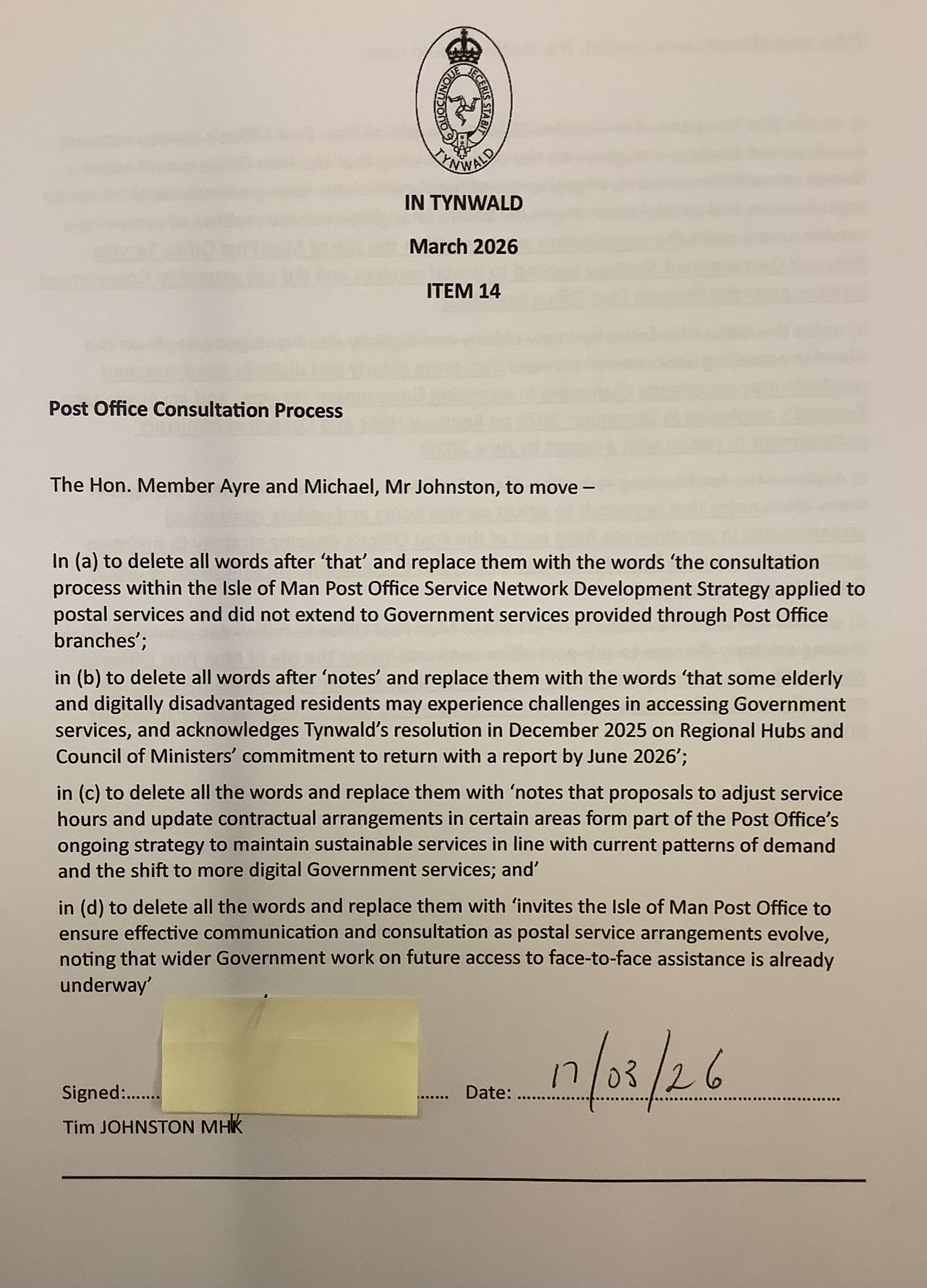
The amendment was passed.
In the House of Keys, 13 MHKs voted in favour, 10 against.
In the Legislative Council, five MLCs voted in favour, 3 against.
 Investigation underway following Sea Terminal incident
 Manx pharmacist reacts to UK meningitis outbreak
 Flagship social housing project officially opens in Douglas
 Bid to extend Manx territorial waters to the median line scrapped
