
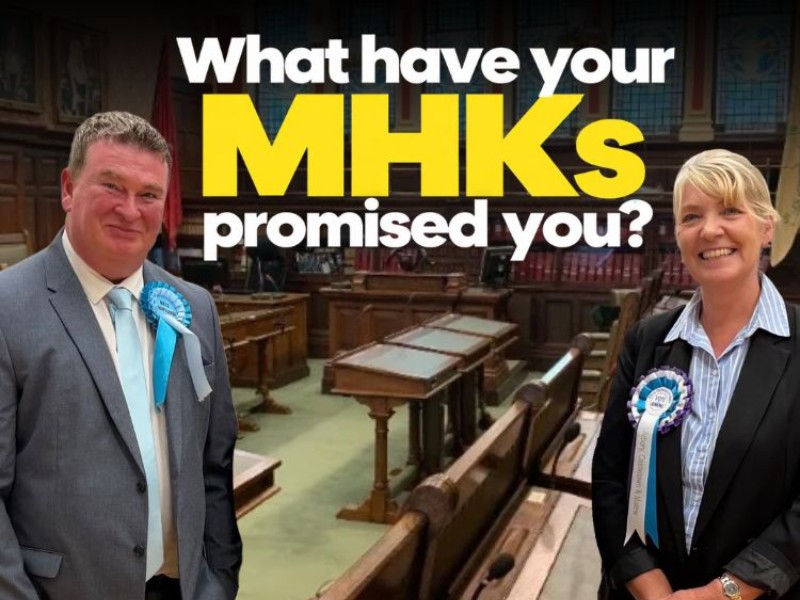
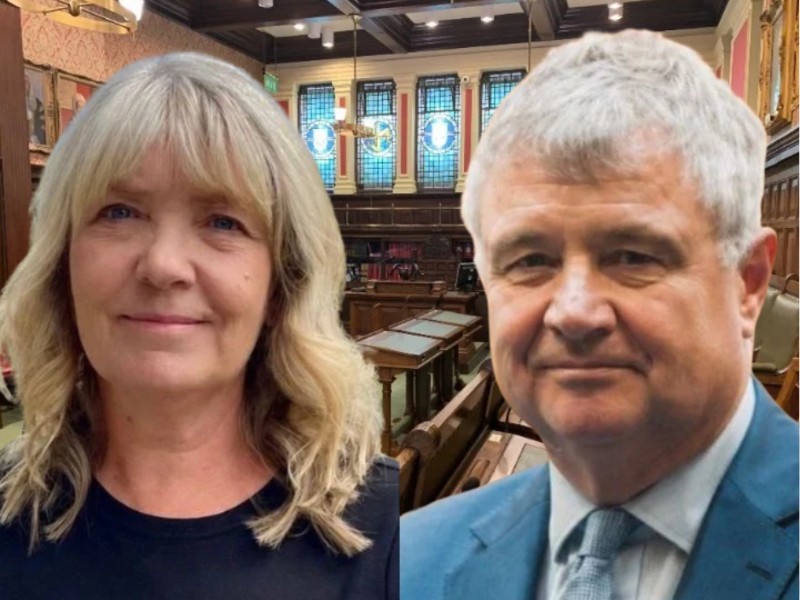
Kirrie Jenkins and Jason Moorhouses were elected
The constituency of Arbory, Castletown, and Malew returned two candidates to the House of Keys in Kirrie Jenkins, a first-time MHK and parish commissioner, and Jason Moorhouse, a veteran backbencher and former teacher.
While their campaign styles and priorities differed, they will have to work together for the next five years. But when it boiled down to the key issues facing the next administration, what did they say throughout the campaign?
Housing
Both candidates identified housing as a crisis requiring urgent action, though their proposed mechanisms differed.
Jason Moorhouse pointed to his record in the previous House of Keys and work that led to changes in first-time buyer schemes, social housing income thresholds, and the homelessness strategy. His manifesto proposed government bonds to open up home ownership for those who currently rented, rent-to-buy schemes, and the release of serviced plots in local areas. He called for an immediate review of the housing market to identify delays and issues experienced when purchasing property, with the aim of freeing up the market for local people.
Kirrie Jenkins framed housing as a matter of people, not just houses. She advocated for exploring ground rents where the local authority or government retained ownership of the land to support long-term housing provision. She argued this could reduce the upfront cost of a first-time buyer property by up to a third and free up social housing. She also wanted to make better use of existing government buildings and land, and highlighted ongoing developments at School Hill in Castletown as an example of innovative thinking.
Energy
While both sceptical of the plans for onshore and offshore wind, the two differed on which path they want the Island to take.
Kirrie Jenkins was firmly opposed to the proposed onshore wind farm at Earystane and Scard. Her manifesto described it as an industrial zone for large-scale turbines, and she helped establish the opposition to the project. She argued the Island's energy strategy should be designed around what was best for the Island, not forced to fit an unrealistic timetable. She supported distributed solar, more efficient generation, new turbine technologies, and emerging fuels. Crucially, she wanted to review the Climate Change Act and the Island's Net Zero targets, stating in her manifesto that existing targets should not be treated as untouchable. In the debate, she said: "We shouldn't be frightened of looking at the dates and seeing if they're realistic, seeing if they're the right thing for our economy at this point in time."
Jason Moorhouse was a vocal questioner on the wind farm issue, tabling multiple questions about the Manx Utilities' turbine plans. His manifesto called for an assessment of renewable options that focused on appropriate location and cost. Notably, he also wanted the option of gas extraction to be considered, noting that a team was looking at a low-emissions option. In the debate, he said: "There are real concerns here, but there are also equal opportunities. Can we look at gas in terms of can we extract the gas in a way that's going to have no actual emissions? So, there are opportunities, and we need to look at those."
Government Reform
Both candidates wanted a smaller, smarter government, but their proposed mechanisms differed.
Jason Moorhouse made government overspend his signature issue. He repeatedly highlighted that over half a billion pounds had been removed from reserves in the last five years, calling this "normal behaviour" that had to be challenged.
He wanted to identify mechanisms to reduce the size and reach of central government by embracing efficiencies, new ways of thinking, AI, and a focus on boosting productivity. He also demanded more from the Council of Ministers, questioning how they could approve spending on 20mph signs while health operations were paused.
Kirrie Jenkins wanted a more open and accountable government, with decisions backed by evidence, major projects independently scrutinised, and ministers held properly accountable.
Her manifesto proposed a Government Innovation Lab to test new approaches to problems such as homelessness, addiction, education and mental health. She also supported a review asking whether government needed to do something, whether someone else was already doing it and whether the private or third sector could deliver it more effectively.
In Manx Radio's constituency debate, she called for looking at collective responsibility for the Council of Ministers, arguing it was hindering choices and affecting democracy.
The Economy
Both saw economic growth as the foundation for funding public services, but their priorities diverged.
Jason Moorhouse chaired the Economic Policy Review Committee, which produced reports demanding a major overhaul of the Department for Enterprise and the creation of a new Tourism Board.
He wanted to restructure the Department for Enterprise, focus on mentoring and work experience in schools, and encourage investment in local businesses.
He also called for the reassessment of moving the Island's reserves into more speculative investments. His manifesto stated: "A strong economy is what pays for good public services."
Kirrie Jenkins wanted to stop taxing small businesses and adding layers of bureaucracy. Her manifesto stated the Isle of Man could not tax its way to prosperity. She supported an Emerging Sector Review to identify new industries where the Island could develop a genuine competitive advantage.
She also highlighted connectivity as an economic issue, noting that unreliable connections deterred investors, talent, and businesses.
Education
Both candidates made the new Castle Rushen High School an absolute priority.
Jason Moorhouse was critical of progress so far, claiming that in March 2026, five companies from the UK and British Isles were interested in taking it forward, but by April, increased freight charges caused them to withdraw. He proposed considering alternatives, including six manor houses around a quad and working with local expertise.
His manifesto also committed to driving forward necessary investment in Ballasalla Primary School and ensuring no further cuts in delivery at University College Isle of Man (UCM).
Kirrie Jenkins served on the board of the Southern Swimming Pool and campaigned for safer walking routes and better parking at Arbory Primary School.
Her manifesto supported delivery of the new Castle Rushen High School and the associated Southern Sports Hub. She wanted career and technical education to have a stronger place alongside traditional academic pathways, with hands-on, job-ready skills for young people. She also wanted difficulties identified early in primary school before problems became entrenched.
The Steam Packet
This topic revealed a significant philosophical difference between the two candidates.
Jason Moorhouse opposed full nationalisation but wanted clearer parameters on what the Steam Packet did. He said in the debate: "I wouldn't nationalise, but there's got to be clear parameters in terms of what this Steam Packet does. At the moment, too much is left for them to decide, and that is inappropriate." He wanted a greater focus on pricing for local residents and freight.
Kirrie Jenkins said she would not nationalise the Steam Packet but would part-privatise it.
She wanted the Steam Packet to join up with other ferry services and provide alternative routes to attract more people to the Island. She also strongly supported a Road Equivalent Tariff (RET) for essential freight services, which would bring down the cost of imports and exports. In the debate, she said it was something that 'the agricultural sector has been crying out for for years'.
Connectivity
Both candidates saw connectivity as essential to the Island's future, but their focus differed.
Jason Moorhouse wanted to continue pushing for greater access to other areas in the British Isles and Europe. He committed to carefully monitoring potential changes to ownership at EasyJet. His manifesto also called for a review of the Island's harbour strategy and both sea and air services, with the aim of providing the reliable connections a successful economy needed.
Kirrie Jenkins made connectivity a central plank of her economic pitch. Her manifesto stated: "Connectivity is an economic issue, unreliable connections deters investors, talent and businesses and creates barriers for residents."
She supported a review of the harbour strategy and both sea and air services. She also wanted to increase connectivity to make it easier to do business, saying that this was currently holding the Island back.
Pensions
This was a topic where both candidates acknowledged the need for action, though neither offered a complete solution.
Kirrie Jenkins said she was not averse to looking at pension reform. In the debate, she stated: "We have got to protect the pensioners for today, but we have also got to look ahead to the future and make sure that our youth are going to have protection in their old age."
She called for a red line to be drawn about the triple lock and said the issue needed to be looked at 'with our heads, not our hearts'. Her manifesto supported an evidence-based review of pensions and the sustainability of the National Insurance Fund and the establishment of a dedicated Older People's Champion.
Jason Moorhouse said this was a key area that had to be looked at by the next administration.
He noted that the Island had been lucky in recent years due to stock market performance, which enabled the issue to go on the back burner. But he warned it needed to be a priority going forward. His manifesto committed to working towards a cap limit for the total cost of older person care and protecting vulnerable people.
Local Government Reform
Both candidates had views on how to reform local authorities, but not on how they could be achieved.
Kirrie Jenkins served as an Arbory and Rushen Parish Commissioner since 2021, including two years as Chair. She highlighted the collaborative work of local commissioners in opposing Clause 5 of a recent piece of legislation, describing it as an example of how local authorities could work together effectively.
In the debate, she said: "All the commissioners working together and collaborating on that shows that we can achieve things. A lot of the local authorities, even themselves, would admit that they've not always got on, but we were united on that and that collaboration is what we need now in the House of Keys."
Jason Moorhouse also worked closely with local authorities, particularly through the Destination First Board, which he helped create following a motion designed to improve the look of the Island.
His manifesto described this as bringing about fundamental change by getting core government departments, Manx National Heritage, and local authorities to 'come together and work together'. An example he cited was the Community Ranger project, where volunteers worked to improve local areas. His manifesto also called for a focus on entrepreneurial outcomes, to include local authority reform.
 Chief Minister candidates take questions from MHKs
 German supermarket giant has 'noted interest' in Island
 Stab wound force 'at severe end of scale'
 Polls open for Marown Commissioners by-election
