

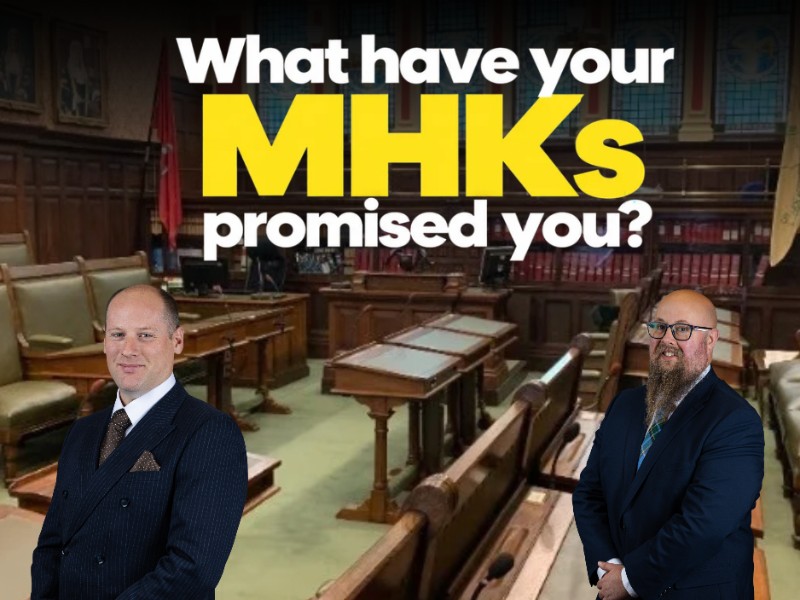
Juan McGuinness and Robert Cowell were elected
Ramsey picked two new MHKs to represent them for the next five years earlier this summer in Juan McGuinness and Robert Cowell.
Both candidates agreed that government cost too much and delivered too slowly, but they came at the Island's challenges from different angles.
Mr Cowell framed his campaign around business experience, having built companies and served as Chairman of Ramsey Town Commissioners. Mr McGuinness framed his around a decade in local government, arguing he knew his way around the system without being institutionalised by it. Both ran as independents, both prioritised Ramsey, and both promised to hold government to account.
Housing
Mr Cowell framed housing as part of a wider ambition to create an island where young people chose to stay. His manifesto prioritised using land already available more intelligently, bringing empty properties back into use, and building more homes without automatically turning to greenfield development. He also supported more affordable homes and social housing, and wanted to improve routes into home ownership.
Mr McGuinness called housing the single most important issue on the island. He argued government had spent too long describing the problem and not enough time delivering homes, pointing to a Ramsey site identified in 2021 for 30 flats that was still only at the planning stage. He wanted a clear delivery pipeline, with government identifying stalled sites and explaining who was responsible for moving them forward. He also criticised schemes that were not delivering, including where affordable homes were not genuinely affordable or support was too difficult to access.
Energy
Mr Cowell addressed energy directly in his manifesto. He supported reducing carbon emissions where it was practical, affordable, and delivered genuine benefit, but placed energy security and affordability first. He argued the island should keep its technological options open rather than betting its future prematurely on any single solution. On Mooir Vannin, he said any decision must be based on robust evidence and value for the Manx public, and stated he would not support a project simply because government had already invested time or political capital in it.
Mr McGuinness did not set out a detailed energy position in the documents provided. He did refer to green energy grant schemes, noting they were not available to local authorities, which he described as madness. He identified himself as a pragmatic individual rather than a green person.
Government Reform
This was a signature issue for both men, but they approached it differently.
Mr Cowell was a vocal critic of what he called government inertia, arguing there was too much consultation and not enough decision-making. His manifesto committed to greater discipline over public spending, clear accountability for major projects, meaningful performance measures, less unnecessary bureaucracy, faster decision-making, and greater use of public-private partnerships where they delivered better value.
His stated test was whether government knew what it was trying to achieve, knew what it cost, measured whether it worked, and took responsibility when it did not. He also suggested local government should be given more power and more money, freeing central government from being pecked at for every issue.
Mr McGuinness argued the House of Keys needed more scrutiny, more challenge, and a stronger focus on accountability.
He wanted a smaller number of government priorities, with resources following them and clear political ownership of major projects. He criticised the current scrutiny committee structure as stable door after the horses bolted, arguing scrutiny should be applied to the island plan before it was issued, not after. He also highlighted siloed departmental thinking, giving the example of education budget savings that simply moved costs to other departments rather than saving government money overall.
The Economy
Mr Cowell made growing the economy his first priority.
He wanted the Isle of Man to become one of the best places in the British Isles to start, grow, and scale a business. His manifesto committed to faster planning and licensing, smarter regulation, competitive taxation, modern digital government, backing entrepreneurs and small businesses, developing finance, technology, maritime and emerging industries, preparing the workforce for AI, and investing in skills and apprenticeships.
He argued the private sector was the answer to many of the island's challenges and that government was too involved in everything, suggesting the DFE should be a facilitator and empowerer rather than a controller. He supported public-private partnerships, giving the example of housing development where buying private units rather than building through government could save significant sums. He questioned whether a population target of 100,000 was necessary, suggesting the right number depended on balancing GDP and cost.
Mr McGuinness wanted to back an economy that gave people a future on the island. His manifesto supported sustainable growth and stronger local businesses so people could afford to live here, build careers, and put down roots. He wanted to protect and promote Ramsey's high street, with its independent shops and free parking, and support demand for smaller offices, shared meeting space, and modern workspace.
He criticised government business schemes measured by their existence rather than take-up, investment unlocked, and results, and wanted schemes to have meaningful performance measures, regular reviews, and quicker changes when they were not working. He also highlighted the need to incentivise developers to redevelop brownfield sites, arguing town centre development was not currently attractive due to higher costs and lower returns.
Education
Mr Cowell committed to preparing the workforce for AI and the changing world of work, and investing in skills, apprenticeships, and lifelong learning. He wanted young people growing up in Ramsey to believe they could build a career, build a business, buy a home, and build a life on the island. He also wanted to create opportunities so children did not have to leave the island to fulfil their ambitions.
Mr McGuinness wanted an education and skills system that gave people the best chance to succeed, whatever their needs, abilities, or ambitions. His manifesto argued too much emphasis could be placed on academic routes when apprenticeships, trades, and practical skills were equally valuable.
He wanted stronger links between education, employers, and economic development, and said apprenticeship support should reflect the real cost to small employers of training someone. He supported targeted retraining where it improved employment prospects or addressed genuine skills shortages. He also criticised the siloed approach to budget savings in education, giving the example of reduced school swimming lessons that saved money in one department but reduced income to regional pools and bus services, resulting in no net saving to government.
Steam Packet and Connectivity
Both candidates wanted to see improved connectivity for the Island on air and sea routes.
Local Government
Mr Cowell served four or five years on Ramsey Town Commissioners, reaching the rank of chairman. He described local government as an entity in its own right that was still controlled by central government, and argued it needed more power and more money so it could take better control of regional matters, giving central government a break.
He also suggested local government reform could allow some planning decisions, such as a domestic skylight application, to be handled locally rather than by central government.
Mr McGuinness was a commissioner for ten years and was critical of the limitations of local government, stating that what was available to Ramsey commissioners was next to nothing, particularly in terms of grant schemes. He noted local authorities were not eligible for green energy schemes, which he described as madness.
He highlighted that local government could only do so much and that many issues affecting Ramsey, including healthcare, housing, infrastructure, and public services, depended on decisions and funding from central government. He pointed to his record as a commissioner, including proposing that Ramsey Town Commissioners live-stream their public meetings, bringing public art to the town, and calling for a public meeting on the future of Ramsey Cottage Hospital. He argued local government reform could help reduce the deficit by addressing waste in the system.
 Reducing waiting lists 'benefits government finances'
 Weather warning remains in force as Storm Austen arrives
 Manxman: 100 days in dry dock for SPC's flagship vessel
 Return census form or face fine, households warned
