

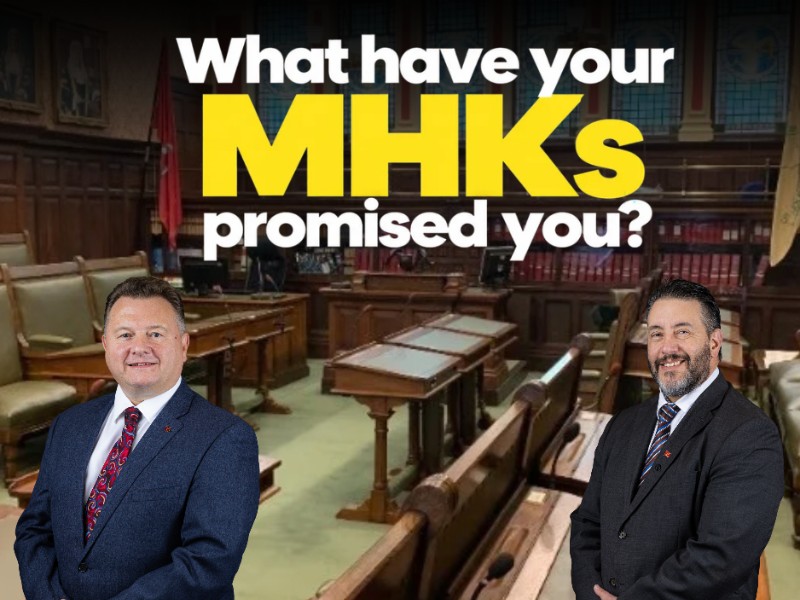
Michael Crowe and Mark Kemp were elected
Following the 2026 House of Keys election, Rushen's two new representatives took their seats. Michael Crowe topped the poll and won the most votes across the entire Island, while Mark Kemp secured the second seat. With Mr Crowe subsequently appointed as Treasury Minister, their positions on the major issues facing the Island carry significant weight. Here is a summary of where both men stood.
Housing
Mr Crowe identified two core issues in the south: the availability of affordable first-time buyer housing and the adequacy of social housing provision. He called for a full-scale review of social housing, arguing that provision had not kept pace with population growth in areas like Port Erin. He also wanted to address the shortage of smaller social units and flats so residents could downsize, freeing up larger family homes. To help young people get on the property ladder, he advocated reviewing existing support schemes and exploring options such as interest-free, deferred repayment loans.
Mr Kemp framed housing as a matter of national resilience and security. He pointed to the objective housing report and its projections for thousands of new dwellings by 2041, arguing that the Island was not building anywhere near enough affordable or social houses. He noted that local authorities with land were being slowed by the loan petition process, while those without land, such as Port St Mary, were effectively landlocked. He also highlighted the pressure that inward migration placed on housing and benefits, arguing that the Island needed economic migrants who paid into the system rather than dependents and low-skilled workers who might be a net drain.
Energy
Mr Crowe took a sceptical view of the current renewable energy agenda. He did not support the proposed onshore windfarm and was equally opposed to offshore wind farms, arguing that both offered poor value for the cost and disruption involved. His alternative vision for energy security was a diversified mix: promoting solar power, exploring additional electricity interconnectors to the UK, upgrading the Island's power station, and backing exploration for natural gas in Manx territorial waters.
Mr Kemp was firmly against the onshore and offshore wind farm proposals, describing them as a major concern raised by constituents. He was critical of the government's approach to renewable energy, arguing that the Island should not pursue large-scale projects without proper scrutiny. His broader position on energy tied into his focus on national resilience, where he highlighted the state of the Island's water infrastructure as an example of a system that would struggle to cope with population increases.
Government Reform
Mr Crowe believed the Isle of Man was well served by its independent, non-party political system, which he viewed as a source of political stability. He argued that effective collaboration between government, industry, and regulators was what had delivered the Island's past successes. While acknowledging that a single MHK had limited power, he believed his background in the financial services community equipped him to bring the right people together to deliver on major projects.
Mr Kemp made public accountability and legislative reform a central pillar of his platform. He proposed a Manx Integrity and Resilience Act, which would audit existing legislation to determine what was being utilised, what was not, and what needed to be repealed. He argued that government had become too reliant on regulations rather than primary legislation. He also wanted a forensic audit of Manx Care, citing issues such as IT systems that did not communicate, excessive bureaucracy, and a management structure he considered not fit for purpose. He was a vocal critic of capital projects going over budget, specifically citing the Liverpool Ferry Terminal.
The Economy
Mr Crowe placed economic growth at the very top of his agenda, describing it as the foundation for everything else government did. He argued that only a thriving private sector could generate the revenue needed to fund public services. His primary focus was on the financial and professional services sector, where he saw a post-MoneyVal opportunity to reset the government's relationship with the industry and reinvigorate the Island's appeal to international firms. He was clear that the Island could not stand still while other jurisdictions competed for business.
Mr Kemp framed his economic approach around diversification and renewal. He warned of significant threats, including the MoneyVal audit, which could result in an 11% hit to GDP and a loss of £140 million in annual income if not handled correctly. He also identified Pillar Two tax as a risk, noting that the 15% multinational corporation tax rate could prompt companies to leave, potentially costing 1,000 jobs. He advocated for new sectors such as vertical farms, adventure and wellness tourism, modular builds, age tech, e-residency, and food security. He also called for a forensic audit of Manx Care to address wastage.
Education
Mr Crowe made the delivery of Castle Rushen High School a central pledge. He noted that the project had been discussed for at least 20 years and argued that it simply needed a decision and delivery. His action plan included employing a dedicated, incentivised project manager to deliver the build on time and on budget, ensuring contracts went to local tradespeople wherever possible, and designing a school that was fit for purpose for the next 50 years.
Mr Kemp identified education and skills as one of his four key pillars. His central proposal was to introduce vocational pathways earlier in schools, from Key Stage Three and Four, to cater for different types of learners. He argued that the current system was geared towards university or office jobs and failed to provide practical routes into trades. To bridge the gap between school and employment, he proposed repurposing the Manx Development Corporation into a Manx Development and Skills Corporation, working with University College Isle of Man to create more apprenticeship opportunities.
Steam Packet and Connectivity
Mr Crowe took a commercial approach to the Steam Packet, arguing that as a government-owned asset, it should be judged on more than just its balance sheet. He wanted to see much more dynamic and flexible pricing on off-peak sailings, alongside targeted travel packages for local sports clubs, community groups, and firms bringing visitors to the Island. He was critical of the current arm's length model, arguing that government should interfere more directly to reduce fares and increase occupancy.
Mr Kemp identified the cost of getting on and off the Island as the real problem facing the economy, arguing that it made everything more expensive. He supported the idea of dynamic pricing but cautioned that a balance had to be struck, as people would hold out for cheaper and cheaper fares if the system was not managed carefully. He noted that the Steam Packet rented the harbour from the Department of Infrastructure, suggesting there might be scope to roll some of that money back into the service to subsidise fares.
Local Government
Mr Crowe had direct experience of local authority structures, having worked on local authority public audit as both a trainee accountant and a partner. He acknowledged that the relationship between government and local authorities had often been tense and argued that it should not have been that way. He believed there was inevitable change coming in how local authorities were organised and structured, particularly as communities grew together, and he advocated for collaboration and resource sharing in the ratepayers' interest.
Mr Kemp was a serving commissioner and had been actively involved in local government reform. He was instrumental in opposing Clause Five of the Local Government Bill, which he described as an assault on rates. He wrote an evidential paper with over 70 questions that he said contributed to the clause being dropped. He argued that local authorities needed more support from central government, noting that there were only two people working in the local government team at the Department of Infrastructure. He advocated for cooperation over confrontation and evidence-based collaboration.
 Manx businesses urged to check whether websites use PHP
 Decision to raise freight fuel surcharge 'not taken lightly'
 Friday's Larne sailings cancelled due to adverse forecast
 Local haulier says latest Steam Packet fuel surcharges can't be absorbed
