
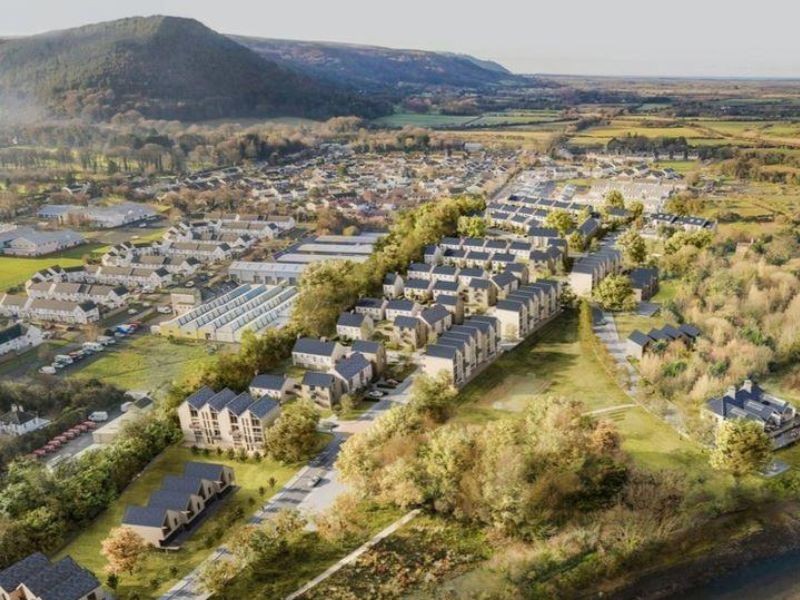
We look at some of 2021's hottest topics and see where we are five years later
One of the biggest concerns for people during the 2021 general election was housing.
To provide a bit of context, it was a year we saw house prices sky rocket on the Island.
The average house price on the Isle of Man jumped to £361,826 - a 15.6 percent increase from 2020, and the median price was around £321,000.
That was partly due to the fact there was more demand - as we lived through the numerous lockdowns, outdoor space with a property became an extremely valuable commodity, with many people looking to relocate to bigger properties with access to a garden in particular.
The Island also saw an influx of people trying to move here from the UK because our coronavirus restrictions were so much more relaxed in comparison to our neighbours across the water.
All this led to fewer properties available and at inflated prices - there was an increase in the number of 'gazumping' incidents (people jumping in and overbidding on a property at the last minute just to secure it) and the homes that were available were snapped up in literally seconds.
It was also the year the Island's rental market started to shift, and the catalyst of that was the Landlord Registration (Private Housing) Act 2021.
Many landlords had concerns about the implementation of the act, and what it would mean for them.
Add that to the rising costs of maintaining their properties and the increase in rates and many just didn't want the hassle anymore.
Interest rates were also so high at the time that for many, arguably they could earn more money having their cash sitting in a bank than by renting out their properties.
As a result, the number of options available on the market started to decrease.
It was also harder than ever for those trying to take that first step onto the property ladder.
Support for first time buyers was fairly minimal, with only a couple of government schemes available and about six opportunities to rent a home at a reduced price to help save up a deposit.
Fast forward to the present day, and how much progress has been made on these issues?
What is the housing market like today?
The market does seem to have stabilised somewhat since 2021, with anecdotally fewer reported incidents of gazumping and not quite so much competition for properties.
However, house prices are still getting higher and higher.
According to Livingstone Surveyors and Valuers, at the end of 2025 the average house price on the Isle of Man was a staggering £391,681.
In 2024, government published the Objective Assessment of Housing Need (OAHN) report which provided critical analysis of future housing requirements and was to be used as an evidence base for the Island’s Strategic Plan.
It also assessed the type of housing the Island is likely to need in the future.
It found the proportion of private renters here has increased from 15 to 20 percent in the past two decades with a reduction in people living in the homes they own by four percent.
And while planning permission has been granted for more than 1,300 properties since 2021, government admitted in September 2025 that only around 300 have actually been built.
How many affordable homes have been built?
Government says the computation is never exact because there could be date differences for the issue of Completion Certificates.
However, it says from the fourth quarter of 2021 until December 2025 there has been around 334 affordable homes built, which includes public sector homes for rent and first time buyer properties.
In addition, some of the affordable dwellings were straightforward replacements for those deemed to be no longer acceptable for modern residential use, like the Peel Road Douglas City Council apartments replacing those on Lord Street.
Meanwhile, a total of 342 affordable homes are included in existing planning approvals for schemes planned to be constructed, subject to being undertaken within the period covered.
At the start of this administration, government committed to 1,000 affordable homes being built in the next decade (2031).
Has the rental market stabilised?
In 2026, it's still very hard to get a rental property.
Many of the things impacting the rental market in 2021 remain issues today.
The Landlords Registration (Private Housing) Act 2021 is in the same place it was five years ago, and hasn't moved along at all.
When I asked DOI for an update on the enactment of the legislation, I was told "the work is well developed but the Housing Agency Board is considering current priorities".
I'll leave you to decide what that means and whether we'll see any movement on it in the last few months of this administration.
Meanwhile, despite a commitment to build more social houses during this administration, only 69 have actually been built.
According to the Department of Infrastructure, on 6 April 2021 there were 6,214 social houses, while on the same date in 2025 there were 6,283.
Is getting on the property ladder any easier?
Getting on the property ladder remains a challenge for many people on the Isle of Man in 2026.
There could be some hope on the horizon though for first time buyers.
Government currently offers two different shared equity schemes, and at the last Government Conference of this administration in September 2025, it announced plans to expand those schemes.
It intends to increase the level of financial support available for first time buyers, as well as widen the eligibility criteria.
The chief minister's hoping to increase the salary thresholds and the upper limit on purchase prices, as well as expanding the level of support for the 'Choice' scheme which allows for purchases on the open market.
This work will be led by the newly-created Housing Agency, however it's arguably been left quite left in the day to see any changes happen during this administration.
However, Infrastructure Minister Tim Crookall says a public consultation on the changes has now been completed, and hopes to be able to bring the plans to Tynwald in May.
If the changes aren't supported though, there'll only be two sittings of this administration left to amend them and bring them back to the table before they become a problem for the next cohort to deal with.
How has this administration tackled the issue?
Shortly after the 2021 election, the new chief minister announced the creation of a new Housing and Communities Board.
Its aim was to look into the housing issue, working to put all housing policy, law and provision in one national strategy in the hope of providing suitable and affordable homes for everyone.
It oversaw the OAHN report to get an idea of the Island's needs when it comes to housing.
Meanwhile, government established a new Housing Agency last year within the Department of Infrastructure.
Its purpose is said to accelerate the construction of affordable homes and to improve access to housing.
It will also take over the DOI's social and affordable housing schemes.
Income from them will be ringfenced to help support future projects, while funding will also come from developers in lieu of building affordable homes themselves.
The agency will only manage government-owned social housing and will not manage local authority stock.
There's more information about the agency and what its aims are here.
Will housing still be an issue on the doorstep in the 2026 general election?
In short, yes.
Mainly because seemingly none of the problems people were facing in 2021 appear to have been resolved.
Yes, the buying market is more fluid again, but that's down to the natural movement of the market itself, not to do with any policies government has implemented.
It's still nearly impossible to get a rental property, many of the wait lists for social housing are still years long, and first time buyer support hasn't yet changed and is still fairly minimal.
So it looks like candidates will be spending a considerable amount of time discussing housing in the run up to the election.
But the question will be, can the next administration do any better?
 Boss of DESC urges staff to “speak up” during Tynwald whistleblowing hearing
 Hopes DOI and striking bus drivers could meet
 Blocked gullies found to be cause of Castle Street flood
 'Only a very small number' needing support cashing benefits cheques
